
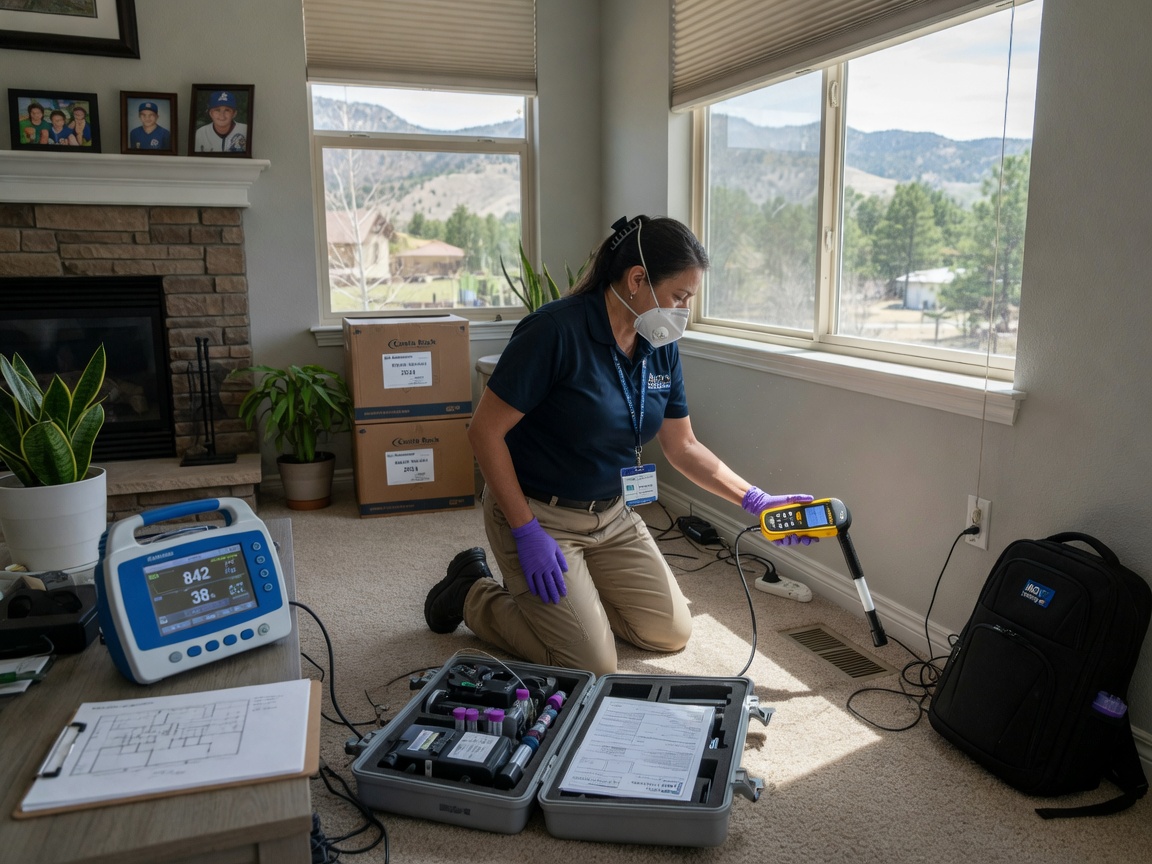
Castle Rock sits in Douglas County where semi-arid conditions produce abundant fine dust and pollen that forced-air systems pull indoors during both sunny stretches and snowy winters. Homes in Downtown Castle Rock often date to the 1970s or earlier with original ductwork that collects construction debris and insulation fibers, while newer builds in The Meadows and Founders Village can off-gas adhesives and flooring materials for years. Testing must therefore sample supply and return runs separately and check for temperature inversions that trap combustion byproducts near the ground during cold snaps.
Technicians collect air and surface samples across multiple rooms, paying special attention to basements and crawl spaces where Douglas County’s variable soil moisture can support hidden mold growth once furnaces run continuously. Results flag elevated particulate counts common near the Castle Rock Outlets and Rock Park trailheads, where wind carries road dust and construction particles. Reports include HVAC-specific recommendations such as filter upgrades or duct sealing rather than generic purifier suggestions.
Local code requires proper combustion-air intake on newer high-efficiency units; older systems in Lone Tree and Parker-adjacent neighborhoods frequently fail this check, raising carbon monoxide risk when windows stay closed against winter cold. Testing protocols follow ASHRAE and EPA sampling intervals but adjust dwell times for Castle Rock’s low humidity, which dries out sampling media faster than in Front Range cities with more moisture.
Homeowners in Highlands Ranch and Parker often request repeat visits after wildfire smoke events, because Castle Rock’s elevation and wind patterns pull particulates into attics and then into living spaces through unsealed penetrations.
Technician insight
In Castle Rock the thing that catches most people out with Indoor Air Quality Testing is how quickly the dry winter air and continuous furnace runtime concentrate fine dust from the surrounding terrain inside ductwork of 1990s homes in Founders Village; one missed supply-run sample and the report misses the real source.
Founders Village townhome after new carpet install
Residents noticed headaches after installing carpet in a Founders Village townhome. Testing revealed elevated VOCs in the upstairs supply air. We isolated the return in the affected bedroom, recommended a 24-hour flush with outside air, and retested to confirm levels dropped below residential guidelines.
Indoor Air Quality Testing Services We Offer
✓Mold Spore Air Sampling
Collects and analyzes airborne mold spores from multiple zones, identifying species common after winter snow melt in Douglas County crawl spaces.
✓Volatile Organic Compound Screening
Measures off-gassing from new flooring, paint, and cabinetry typical in recent construction around Founders Village and The Meadows.
✓Combustion Byproduct Testing
Checks carbon monoxide and nitrogen dioxide levels from furnaces and water heaters, especially important in older Downtown Castle Rock homes with shared flues.
✓Particulate Matter Profiling
Quantifies PM2.5 and PM10 from regional dust, pollen, and nearby highway traffic that HVAC systems recirculate during dry spells.
✓Humidity and Moisture Mapping
Records relative humidity and hidden moisture pockets that develop when semi-arid air meets heated indoor surfaces during winter.
✓Allergen and Pollen Load Assessment
Evaluates indoor allergen concentrations from outdoor sources near Rock Park and Douglas County Fairgrounds that enter through open windows in shoulder seasons.
Indoor Air Quality Testing Cost in Castle Rock, CO
| Service | Typical Range | What Affects It |
|---|---|---|
| Basic IAQ Panel | $275–$425 | Four samples, common contaminants; smaller homes in The Meadows |
| Comprehensive Testing | $550–$850 | Mold, VOCs, combustion gases, particulates; older Downtown Castle Rock homes |
| Post-Remediation Verification | $225–$350 | Retest after duct cleaning or mold work |
| Wildfire Smoke Assessment | $300–$475 | Particulate and VOC focus after regional fire events |
Ranges are typical for Castle Rock, CO and confirmed with an exact written quote before any work starts.
How it works
- 1
Site Walkthrough
Technician inspects HVAC equipment, duct layout, and home age indicators in neighborhoods such as The Meadows or Downtown Castle Rock.
- 2
Multi-Zone Sampling
Air and surface samples are taken from living areas, returns, and supply registers while noting outdoor conditions near Castle Rock Outlets.
- 3
Laboratory Analysis
Samples are sent to an accredited lab for identification of mold, VOCs, particulates, and combustion gases.
- 4
Report and Recommendations
Findings are reviewed on-site with the homeowner and tied directly to the existing furnace and duct system.
- 5
Follow-Up Testing Option
Optional retesting after repairs confirms levels have dropped, especially useful after wildfire smoke or new construction.
Pricing
Most Castle Rock homes fall in the mid-range; larger or older properties require more samples and move toward the higher end.